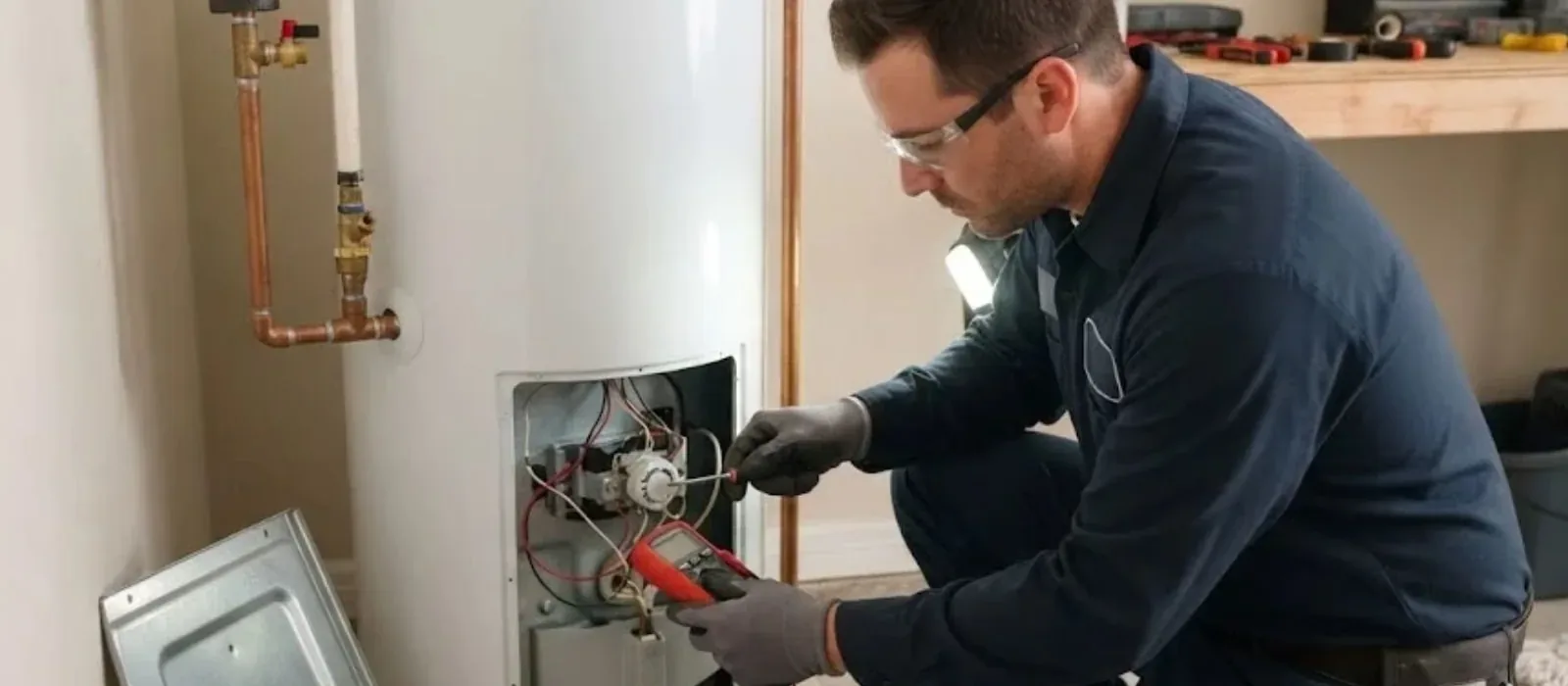
First find out whether you have a gas or an electric tank. On a gas unit, check that the pilot or igniter is working, the gas valve is open and the thermostat is set to heat. On an electric unit, check the breaker and the red reset button.
If a check works the first time, you are done. If the unit trips again, smells like gas, leaks or shows scorch marks, stop and call a licensed plumber.
Start by confirming what kind of heater you have
A gas tank has a gas pipe going into a control valve at the bottom and a flue or vent pipe leaving the top. An electric tank has thick wiring going into a panel on the side or top and no vent. If you cannot tell, look at the label on the tank.
Also check whether the whole house is without hot water or just one faucet. If only one faucet is cold, the problem is likely in that fixture or its mixing valve, not the tank.
Gas water heater: checks in order
Do these with the area dry and no gas smell. If you smell gas at any step, leave first.
- Look for the pilot or igniter light. Many newer units show a status light. Older units have a small pilot flame you can view through a window. If it is out, follow the relighting steps printed on the tank label.
- Check the gas valve. The handle on the pipe leading to the heater should line up with the pipe when open. A bumped handle is a common cause.
- Check the thermostat dial. Someone may have turned it to vacation or pilot. Return it to a normal setting.
- Check for power if it is a power vent. These models need an outlet and sometimes a switch. A tripped breaker or a loose plug stops the fan.
- Look at the vent pipe. A disconnected or blocked flue means the heater will shut itself down for safety. Do not run it like that.
If the pilot lights but will not stay lit, the thermocouple or gas control may be failing. That is a repair for a plumber, not a repeated relight.
Electric water heater: checks in order
Electric units hold power inside the cover panels. Do not open them with the breaker on.
- Check the breaker. Find the dedicated breaker, usually a double switch, and see if it is tripped. Flip it fully off and then on once.
- Press the reset button once. On many units the button sits behind a panel, so turn the breaker off first, open the panel and press it once. If you are not comfortable doing that, call.
- Check the thermostat setting. Make sure it is not set to its lowest position.
- Consider the upper and lower elements. If the water is lukewarm or runs out fast, one element may have failed. That needs a meter test, which is a licensed trade task.
A reset button that trips again and again points to a fault, not a nuisance. Do not keep resetting it.
What the symptom tells you
Use this to match what you see to the likely cause.
| Symptom | Gas unit | Electric unit |
|---|---|---|
| Nothing at all. | Pilot out, gas valve closed, thermocouple. | Tripped breaker, reset button, failed thermostat. |
| Lukewarm only | Thermostat set low, dip tube cracked, sediment. | One failed element, thermostat issue. |
| Runs out quickly. | Sediment, dip tube, undersized tank. | Failed lower element, sediment. |
| Rumbling or popping. | Sediment baking on the burner side. | Sediment on the elements. |
| Water at the base. | Tank leak or fitting, shut off and call. | Tank leak or fitting, shut off power and call. |