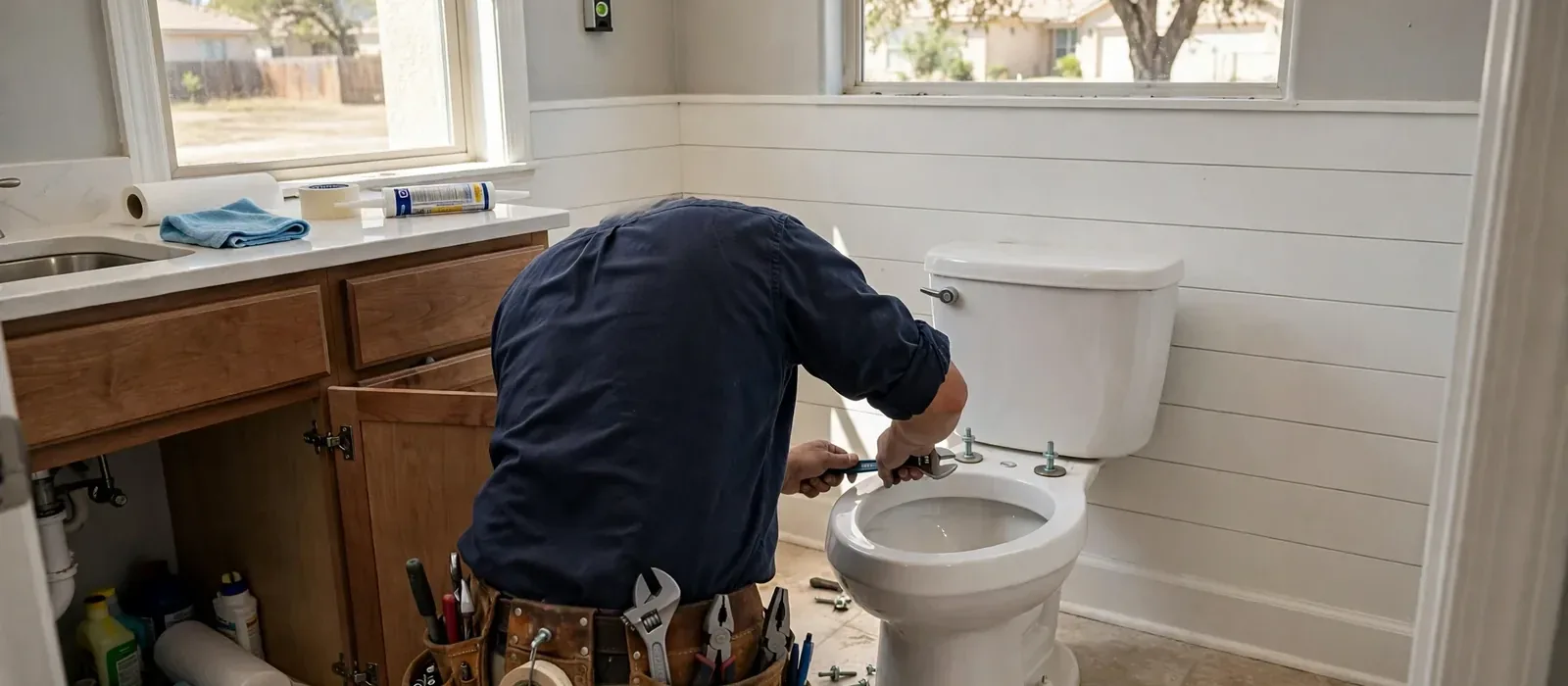
A homeowner can often replace a toilet in the same spot with a similar one. New Jersey treats that as ordinary maintenance, but owner-performed plumbing is only allowed in your own single-family home, per NJ DCA guidance.
Call a plumber if you rent, live in a two-family or multi-unit building, see a damaged flange or soft floor, or want to move the toilet. Those are not like-for-like jobs.
Who may legally do this work
NJ Department of Community Affairs guidance, reporting the position of the Board of Examiners of Master Plumbers, allows owner-performed plumbing only in a single-family home the owner lives in. Two-family homes are excluded, and a townhouse qualifies only with its own sewer.
If you rent, own a two-family or share a sewer with other units, hire a licensed plumber. If you are unsure which category your house falls into, ask the Linden Construction Code Department before buying parts.
What the code says about a swap
N.J.A.C. 5:23-2.7 lists replacing a fixture with a similar fixture, with no change to the piping, as ordinary plumbing maintenance. No permit is needed for that. Moving a toilet to a new location is different, because it alters drainage and vent piping, which is not ordinary maintenance.
So a swap in the same spot is simple on paper. Rebuilding the pipe underneath is not.
DIY or plumber: a quick sort
Check the left column honestly.
| Situation | Reasonable DIY | Call a plumber |
|---|---|---|
| Same spot, same style, floor solid. | Yes, if you are eligible and comfortable lifting. | If you cannot lift or want it done right once. |
| Flange cracked, rusted or below the finished floor. | No | Yes. |
| Soft or stained floor around the base. | No | Yes, rot may be hidden. |
| Moving the toilet or changing the drain. | No | Yes, and ask about the permit. |
| Second floor bathroom. | Only with experience. | Yes, a leak can damage ceilings below. |
| Rental, condo, two-family. | Not allowed for owner-performed work. | Yes. |
The swap, step by step
This is for an eligible owner with a like-for-like replacement.
- Turn off the supply. Close the small valve on the wall or floor, flush and sponge out the remaining water.
- Disconnect the supply line. Keep a towel and a small bucket nearby.
- Remove the tank bolts and nuts at the base. Loosen them gently. Old bolts can seize.
- Lift the toilet straight up. They are heavy. Get help and lift with your legs.
- Scrape the old wax ring. Cover the open drain with a rag to block sewer gas while you work.
- Inspect the flange. It should be solid, level with the floor and free of cracks.
- Set the new wax ring and toilet. Lower it straight down, press, then tighten the nuts evenly in small turns.
- Reconnect the supply, then test. Open the valve, flush several times and look for leaks at every joint.
Do not overtighten. Porcelain cracks under uneven pressure, and a cracked base leaks.
Red flags that turn a simple job into a plumbing job
A flange that sits below the finished floor often lets the toilet rock and leak. A rotted subfloor cannot hold bolts. A toilet that gurgles when other fixtures run may have a drain or venting problem that a new toilet will not fix.
In those cases our toilet repair and installation visit covers the flange, floor and seal along with the fixture. We will tell you if the issue goes deeper than the toilet.