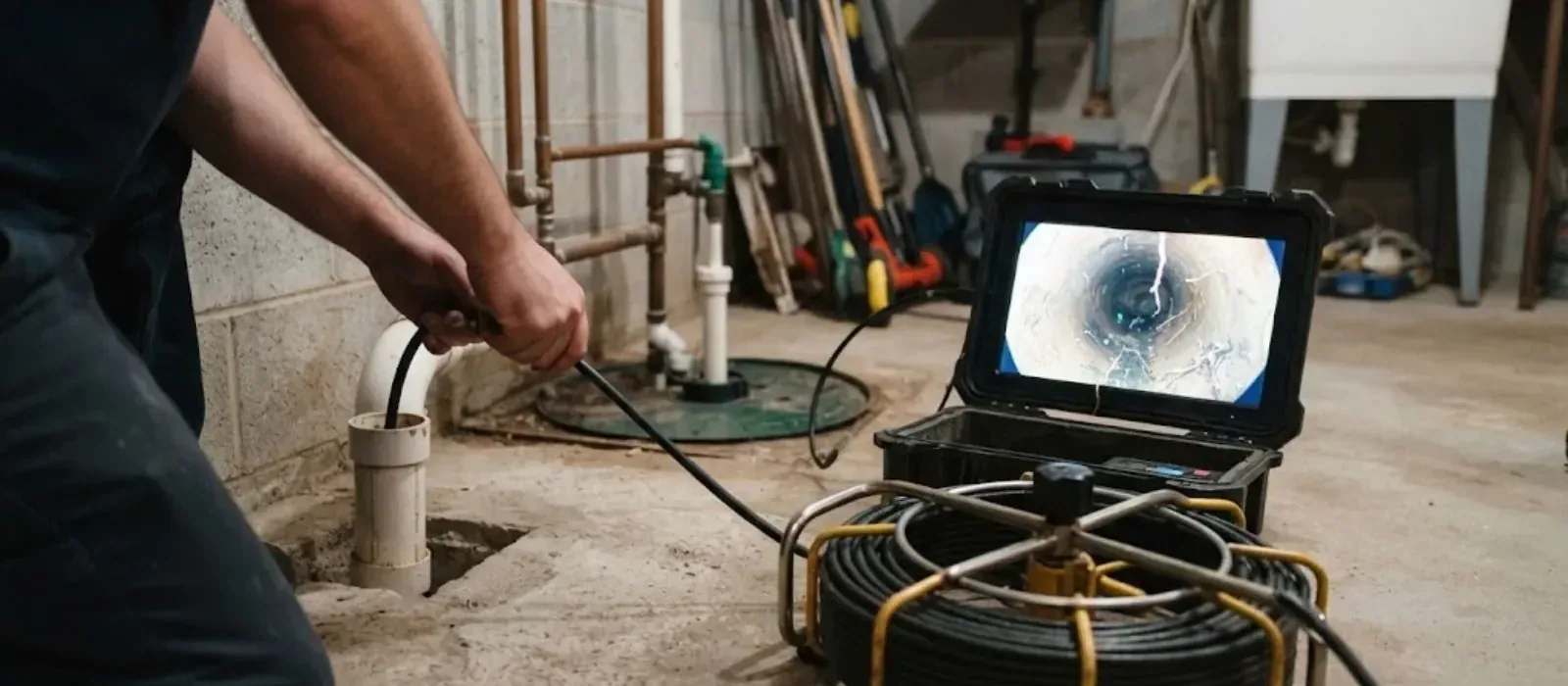
When a toilet and a bathtub clog together, the blockage is almost always in the main drain line they share, not in either fixture. Stop running water, do not keep flushing and do not pour chemicals down.
Check the lowest drain in the house, usually a basement floor drain. If water rises there too, the main line is blocked. Call a plumber, and if a storm is underway, also report it to the sewer authority.
Why Two Fixtures Clog at Once
Every fixture drains into a branch, and branches join into the main line that leaves the house. A toilet clog stays in the toilet. If the tub backs up when you flush, or the toilet gurgles when the tub drains, the two share a blocked pipe downstream.
The lowest fixtures show it first. Water follows gravity, so a basement toilet, shower or floor drain overflows before an upstairs one. Treat a backup in the lowest fixture as the main line announcing itself.
The Basement Floor Drain Test, Step by Step
This test tells you whether the problem is local or in the main line. It takes a few minutes and uses no tools.
- Stop using water. No flushing, showers, dishwasher or laundry until you know more.
- Go to the lowest drain. That is usually a basement floor drain or laundry tub drain.
- Look and listen. Gurgling, a sewer smell or water seeping up means the main is slow or blocked.
- Run one fixture. Run a single upstairs sink for a minute and watch the floor drain. If water appears, the main is blocked.
- Note the pattern. Write down which fixtures were affected and when it started.
- Call a plumber. Tell us what you saw at the floor drain.
If the floor drain stays dry and only the toilet and tub misbehave, the blockage may be in a shared bathroom branch, which is a smaller job.
What Usually Blocks a Main Line
Tree roots are a leading cause. They enter through joints in old clay or cast iron and grow into a mat that catches paper and grease. Grease, wipes, a collapsed pipe section, an offset joint or a belly in the line can also hold waste back.
A camera shows which one it is. We run a camera through the line, mark where the problem sits and then clear it with a cable or hydro jetting. If the pipe itself is broken, clearing is only a short-term fix and the next step is repair. Our sewer line cleaning work starts with the question of what is causing the blockage, not only how to open it.
Who Is Responsible for What
It helps to know who owns each part of the sewer path before you call. This is the general picture. Ask each office about your exact address.
| Part of the line | Usual owner | Who to call |
|---|---|---|
| Fixture and house drains. | Homeowner | A licensed plumber. |
| Line from house to the street. | Ownership varies by address, ask the Authority or City Hall. | A licensed plumber, and the code office if repair is needed. |
| Sewer main in the street. | Ask the Authority or City Hall who maintains it at your address. | The Linden Roselle Sewerage Authority at (908) 862-7100 or City Hall at (908) 474-8493. |
| Treatment plant and interceptors. | Linden Roselle Sewerage Authority. | The Authority. |