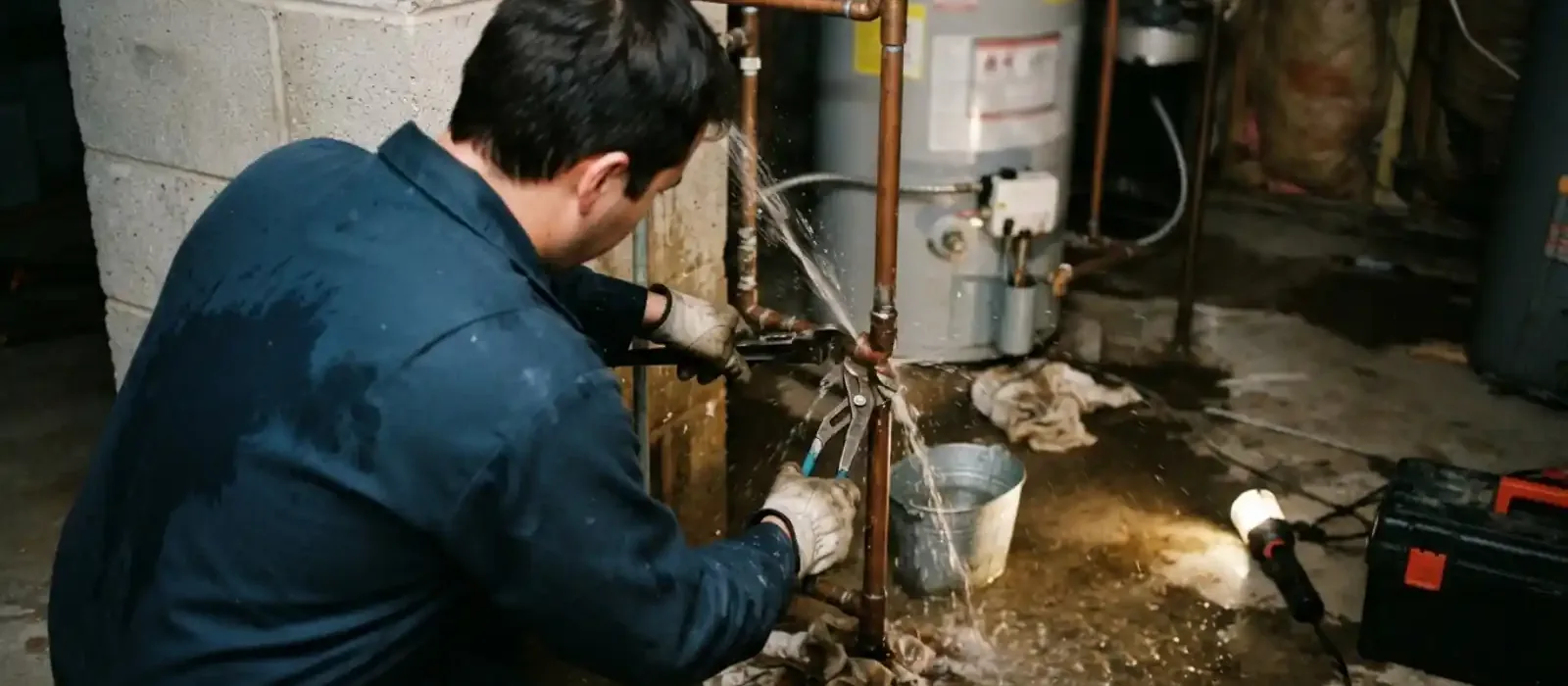
Emergency Burst Pipe Repair in Linden, NJ
A burst pipe turns a quiet house into a flood in minutes. This page covers what to do in the first few minutes, how frozen pipes are handled, and what a repair involves once the water is off.
Call the 24/7 line the moment the water is stopped. We will tell you what to say and what to leave alone.
A Pipe Just Burst: What to Do Right Now
Do these in order. The first step matters far more than the rest.
Close the main shutoff
Turn the main valve clockwise until it stops. It is usually on the wall where the water line enters, often in a basement. If it is stuck, do not force it with a wrench for long, call us.
Drain the lines
Open the lowest faucet and the highest faucet to let remaining water out. Flush a toilet once.
Kill power near water
If water is near the panel, outlets, or a ceiling fixture, do not stand in it. Call 911 for sparks or shock risk, and call an electrician.
Move what you can
Lift rugs, electronics, and boxes off wet floors. Do not lift anything heavy from standing water.
Photograph before cleanup
Capture the pipe, the wet area, and any damaged belongings. Do this before you start mopping.
Why Pipes Split
Water expands as it freezes, and the pressure builds in the section between the ice and the closed faucet. The pipe often splits there, not where the ice sits. Corrosion, a bad joint, and old galvanized steel also fail without any freeze.
County data from the 2013 to 2017 survey puts about 59 percent of Linden housing units as built before 1960. Pipes that age have had decades to thin out, which is why a failure in an old line often means more than one weak spot, and why we may suggest repiping after a repair.
Frozen Pipes: Thaw Carefully, Not Fast
Newark is the nearest weather station we checked, not Linden itself, and its January normal low is 25.5 F. That is cold enough to freeze pipes in an exterior wall, an unheated garage, or a poorly sealed basement window area, so treat that as a regional reference, not a Linden measurement.
If a faucet gives only a trickle in a cold snap, keep the faucet open and warm the pipe slowly with a hair dryer or warm towels. Never use a torch or open flame. If you see frost, a bulge, or any wet spot, shut the main and call, because the pipe may already be cracked and will leak as it thaws.
How a Burst Pipe Repair Goes
Once the water is off, the work is orderly.
- 1Confirm the water is off.We check the main valve works and that no section is still feeding the break.
- 2Find the full damage.Pipes rarely fail in one spot. We inspect the run on both sides for thin walls, bulges, and bad fittings.
- 3Cut out the failed section.We remove the split length back to sound pipe.
- 4Replace with approved material.New pipe and fittings go in, with proper support, then the line is pressurized slowly.
- 5Test and walk the run.We check every joint for weeping and show you the repair before we leave.
Which Failure, Which Fix
Typical patterns, confirmed on site.
| Failure | Common cause | Usual response |
|---|---|---|
| Lengthwise split in a pipe. | Ice pressure | Replace the split section. |
| Pinhole spray from old steel. | Corrosion from inside. | Replace the affected run, consider more. |
| Joint blowing apart. | Poor joint or movement. | Redo the joint and check supports. |
| Burst after thaw, below a floor. | Cracked pipe leaking once ice melted. | Locate the break, then repair. |
| Outdoor spigot split. | Freeze in the hose line. | Replace the hose bib. |
What Decides the Cost of a Burst Pipe Job
We give a clear price before work starts.
Homeowner's policies often cover sudden accidental water damage, such as a burst pipe flood, but usually not the failed pipe itself, gradual leaks, or maintenance. Check your own policy and ask your insurer. For your real number, call.
Before the Cold Returns
A little attention in the fall prevents most freeze bursts.
- Disconnect hoses Remove outdoor hoses and shut the indoor valve to the spigot if there is one.
- Seal drafts Close gaps near basement windows and where pipes enter exterior walls.
- Open cabinet doors On very cold nights, let room air reach sink pipes on exterior walls.
- Know your shutoff Test the main valve once a year so it turns when you need it.
If the main will not close fully, we can replace it. A valve you cannot turn is the real emergency, and our leak detection work can find a slow drip before it becomes a burst.
Pipes in the Yard and Under the Street
Water gushing in a yard or bubbling up from the ground points at the service line, not a house pipe. We cover that on our water service line page. Before anyone digs, call 811.
Water in the street belongs to the utility. Call New Jersey American Water if the main itself is breaking.
Water Is Off? Call Us Next
Close the main, then call. Tell the dispatcher what burst, where the water went, and whether the main closed. We also work in Rahway and nearby towns, and our line is open 24/7.
Permit rules for pipe repair
The state treats repairing a leak by replacing a section of existing pipe as ordinary maintenance. DCA guidance says piping may be replaced to repair a leak. Replacing whole runs of supply piping is not ordinary maintenance under N.J.A.C. 5:23-2.7, so ask the Linden Construction Code Department before a larger job.
Burst Pipe Questions Answered
Yes. The phone line is open 24/7. Say that a pipe has burst, whether you closed the main, and where the water is going. We do not promise a specific arrival time.
Do not keep forcing it. Call us and, if water is pouring in, call the water utility about the street-side valve. We can replace a failed main valve.
A repair clamp or wrap can slow a small leak for a short time, but it is not a repair. Keep the main closed and call.
State rules list replacing or relocating water supply piping as not ordinary maintenance in one section, while another lists repair of leaks by replacing piping as ordinary maintenance. Ask the Linden Construction Code Department.
Often the resulting water damage is covered if sudden and accidental, but the pipe and gradual leaks usually are not. Check your policy, ask your insurer, and take photos first.
Keep a faucet open, warm the pipe slowly, and never use flame. If it stays frozen or you see a wet spot, close the main and call.